
Bible Verses About Money and Greed for Wise Living reveal God’s wisdom for handling wealth with faith, honesty, and contentment. Discover carefully selected scriptures that encourage generous hearts, wise stewardship, and freedom from the love of money.
If you seek biblical guidance for daily finances or spiritual growth, these verses offer lasting encouragement. Use our easy Copy option to save your favorite scriptures instantly. Share God’s wisdom with friends and family using the Quick Share to WhatsApp button. Find the perfect Bible verse and strengthen your faith-filled financial journey today.
Quick Answer
Bible Verses About Money and Greed for Wise Living reveal God’s wisdom about wealth, generosity, contentment, and stewardship. Scripture teaches that money itself is not evil, but loving it above God can lead people away from faith. These verses encourage believers to trust God, live generously, and pursue eternal treasures.
Biblical Meaning of Bible Verses About Money and Greed for Wise Living
Money is neither praised nor condemned in Scripture. Instead, the Bible focuses on the human heart and how people relate to wealth. The biblical meaning of these verses is centered on stewardship, contentment, generosity, and wholehearted devotion to God.
One of the most frequently quoted passages is found in 1 Timothy 6:10:
“For the love of money is a root of all kinds of evil.”
This verse does not teach that money itself is evil. Rather, it warns that when money becomes life’s greatest desire, it can lead people away from God’s truth and into harmful decisions.
Throughout Scripture, wealth is presented as a blessing when received with gratitude and managed wisely. At the same time, greed is consistently portrayed as a spiritual danger because it replaces trust in God with trust in possessions.
In the Old Testament, the Hebrew word often associated with greed carries the idea of unjust gain, selfish desire, or covetousness. It reflects a heart that longs for more regardless of its impact on others.
In the New Testament, the Greek word pleonexia means an insatiable desire to have more. Jesus described this attitude as a serious spiritual problem because it places material things above God’s kingdom.
One of Christ’s clearest warnings appears in Luke 12:15:
“Watch out! Be on your guard against all kinds of greed; life does not consist in an abundance of possessions.”
This statement challenges believers to evaluate what truly gives life meaning. Wealth may provide comfort, but only God provides lasting security and eternal hope.
The biblical interpretation of money always begins with recognizing God as the owner of everything. Human beings are stewards who manage His blessings faithfully.

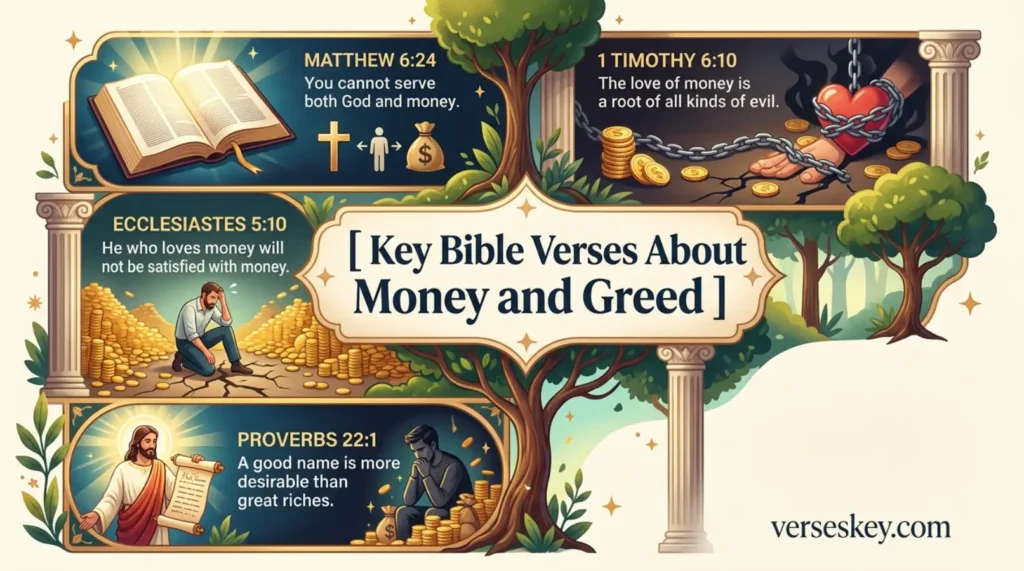
Key Bible Verses About Money and Greed
1. 1 Timothy 6:10
“For the love of money is a root of all kinds of evil.”
Paul reminds believers that misplaced affection toward wealth can damage faith, relationships, and spiritual growth.
2. Matthew 6:24
“You cannot serve both God and money.”
Jesus teaches that every heart ultimately chooses its master. God desires complete devotion rather than divided loyalty.
3. Proverbs 3:9–10
“Honor the Lord with your wealth, with the firstfruits of all your crops.”
Wise stewardship begins by placing God first in every area of life, including finances.
4. Hebrews 13:5
“Keep your lives free from the love of money and be content with what you have.”
Contentment grows when believers trust God’s faithful provision instead of constantly chasing more.
5. Proverbs 11:25
“A generous person will prosper; whoever refreshes others will be refreshed.”
God blesses generous hearts that willingly share with those in need.
6. Ecclesiastes 5:10
“Whoever loves money never has enough.”
This verse reveals the emptiness of greed. Material desires can never fully satisfy the human heart.
7. Luke 12:33–34
“For where your treasure is, there your heart will be also.”
Jesus encourages believers to invest in eternal treasures through faithful living and generous giving.
8. Proverbs 28:22
“The stingy are eager to get rich and are unaware that poverty awaits them.”
Quick wealth gained through selfish ambition often leads to disappointment and spiritual loss.
9. Acts 20:35
“It is more blessed to give than to receive.”
Generosity reflects God’s own character and brings joy beyond financial gain.
10. Malachi 3:10
“Bring the whole tithe into the storehouse.”
This passage highlights faithful giving as an act of worship and trust in God’s provision.
Spiritual Significance and Symbolism
Money symbolizes responsibility more than success in biblical teaching. Every financial blessing becomes an opportunity to honor God and serve others.
Greed symbolizes a divided heart. When people become consumed with accumulating wealth, possessions gradually replace faith, gratitude, and compassion.
Generosity, on the other hand, reflects God’s own generous nature. Throughout Scripture, the Lord blesses His people so they can become a blessing to others.
Contentment symbolizes spiritual maturity. A content believer finds peace regardless of financial circumstances because confidence rests in God’s promises rather than earthly possessions.
The Bible also presents wealth as a test of character. Financial resources reveal priorities, values, and trust. Wise stewardship demonstrates humility, responsibility, and dependence upon God.
Families benefit greatly when biblical financial principles guide daily decisions. Parents who model generosity teach future generations that true riches are found in faithful living rather than material accumulation.
Healthy relationships also flourish when greed is replaced with kindness and generosity. Financial integrity builds trust, while selfishness often creates conflict and division.
Ultimately, these Bible verses remind Christians that lasting joy comes from God’s presence rather than temporary possessions.
Biblical Interpretations in Dreams or Real Life
The Bible does not encourage believers to assign definite prophetic meanings to every dream involving money or wealth. Instead, Christians should prayerfully seek God’s wisdom and compare every experience with Scripture.
If someone dreams about money, it may encourage reflection on personal priorities, stewardship, gratitude, or trust in God’s provision.
Dreams involving generosity may remind believers to care for those in need and use their resources faithfully.
Dreams centered on greed, hoarding, or financial anxiety can serve as gentle reminders to examine the heart and renew trust in God’s care.
During prayer, Bible verses about money often encourage believers to surrender financial worries to the Lord. God invites His people to seek His kingdom first rather than becoming overwhelmed by earthly concerns.
In daily life, these passages provide practical guidance when making financial decisions, choosing careers, planning investments, giving to others, or facing economic uncertainty.
Rather than promoting fear, Scripture consistently points believers toward wisdom, contentment, generosity, and faithful dependence upon God.
Practical Lessons & Faith Insights
- Trust God as your provider. Remember that every good gift comes from Him, even during seasons of financial uncertainty.
- Practice contentment daily. Gratitude protects the heart from constant comparison and unhealthy ambition.
- Give generously. Sharing with others reflects God’s love and strengthens communities of faith.
- Manage money wisely. Good stewardship honors God through responsible planning, saving, and spending.
- Avoid greed. Examine your heart regularly to ensure possessions never become life’s highest priority.
- Pray before major financial decisions. Invite God to guide your choices with wisdom and discernment.
- Help those in need. Compassion demonstrates genuine faith through practical acts of kindness.
- Store up eternal treasures. Invest time, resources, and energy in God’s kingdom rather than temporary wealth alone.
- Remain honest in business. Integrity honors God and builds lasting trust with others.
- Teach biblical financial principles. Passing these truths to children and future generations creates a lasting spiritual legacy.
How This Biblical Meaning Applies Today
Modern life presents countless opportunities to pursue wealth above everything else. Advertisements, social media, and cultural expectations often encourage people to believe that happiness depends upon having more.
The Bible offers a refreshing alternative.
Christians are called to work diligently while remembering that their identity is found in Christ, not in financial status. Success is measured by faithfulness rather than possessions.
Families benefit when they create budgets, avoid unnecessary debt, practice generosity, and pray together about financial decisions. These habits strengthen unity and reduce unnecessary stress.
Churches also reflect God’s love through generous giving that supports ministry, missions, and care for those facing hardship.
Young adults entering the workforce can learn to balance ambition with humility, ensuring career goals never replace devotion to God.
Business owners can honor Christ by treating employees fairly, conducting honest transactions, and serving customers with integrity.
Those experiencing financial struggles can find comfort knowing that God’s faithfulness does not depend upon bank accounts. Scripture repeatedly reminds believers that the Lord cares deeply for His children.
Likewise, those blessed with abundance are encouraged to view wealth as an opportunity for faithful stewardship rather than personal status.
Living according to biblical financial principles creates peace because trust shifts from temporary possessions to God’s eternal promises.
Frequently Asked Questions (FAQ)
What do Bible verses about money and greed mean?
They teach that money is a tool to be managed wisely, while greed is a sinful attitude that places wealth above God. Scripture encourages generosity, contentment, and faithful stewardship.
What is the spiritual meaning of money in the Bible?
Money represents responsibility and stewardship. God entrusts resources to His people so they can honor Him, provide for their families, and help others.
Why is greed considered sinful?
Greed turns the heart away from God by making possessions the highest priority. It often leads to selfishness, injustice, and spiritual emptiness.
What is the most famous Bible verse about money?
One of the best-known passages is 1 Timothy 6:10, which teaches that the love of money is a root of all kinds of evil rather than money itself being evil.
What can Christians learn from Bible verses about money?
Christians learn to trust God, practice generosity, remain content, use resources wisely, avoid greed, and invest in eternal values instead of temporary possessions.
Does the Bible say it is wrong to be wealthy?
No. Many faithful people in Scripture possessed wealth. The Bible warns against placing trust in riches rather than in God and calls wealthy believers to practice generosity and humility.
How can I avoid greed according to the Bible?
Cultivate gratitude, pray regularly, give generously, study Scripture, serve others, and remember that lasting fulfillment comes from Christ rather than material possessions.
Which Bible verse teaches contentment?
Hebrews 13:5 encourages believers to remain free from the love of money and to be content because God promises never to leave His people.
Conclusion
Bible Verses About Money and Greed for Wise Living remind believers that true wealth is measured by faithfulness rather than possessions. Throughout Scripture, God calls His people to trust Him as their provider, manage resources with wisdom, practice generous living, and guard their hearts against greed.
These biblical insights reveal that money is a gift to steward, not a master to serve. When believers place God above wealth, they discover lasting peace, deeper contentment, and greater freedom from the endless pursuit of more.
If you are facing financial challenges, enjoying seasons of abundance, or simply seeking God’s wisdom for everyday decisions, these Scriptures provide timeless guidance. Let God’s Word shape your priorities, strengthen your faith, and inspire a life marked by generosity, integrity, and joyful trust in His unfailing provision.

I am Grace Willow passionate about sharing the wisdom and comfort of Scripture. Through my writing, I explore faith, hope, and the timeless lessons of the Bible. I aim to bring God’s Word to life in ways that inspire and guide daily living. My verses and reflections seek to encourage, uplift, and strengthen readers’ faith. For me, writing about Scripture is a way to connect hearts to God’s love.