
Trending Bible Verses for Healing to Restore Faith offer comfort, hope, and spiritual strength during difficult seasons of life. These encouraging Scriptures remind you that God remains near during pain, uncertainty, and emotional struggles. You will discover powerful Bible verses that inspire healing, renew faith, and encourage you to trust God’s loving promises.
Let these uplifting Scriptures bring peace to your heart and renewed strength to your faith. Each verse can encourage you during challenging moments and help you focus on God’s presence, grace, and promises. Spend time reflecting on these Scriptures through prayer and personal devotion.
Our easy-to-use copy option helps you save your favorite verses for prayer, reflection, or encouragement. Use the quick WhatsApp share button to send these healing Bible verses to family, friends, or anyone needing hope.
Quick Answer
Trending Bible Verses for Healing to Restore Faith remind Christians that God remains near during pain, weakness, and uncertainty. Scriptures such as Psalm 147:3, Isaiah 41:10, Jeremiah 17:14, and James 5:15 encourage believers to pray, trust God’s promises, seek wise care, and remain hopeful through every season.
Biblical Meaning of Trending Bible Verses for Healing to Restore Faith
Trending Bible Verses for Healing to Restore Faith refer to Scripture passages that encourage people to seek God during sickness, suffering, emotional pain, and spiritual weakness. The Bible does not treat healing as merely a physical experience. It connects restoration with God’s mercy, faith, prayer, repentance, comfort, and renewed hope.
Healing appears throughout Scripture from its earliest books. In Genesis 20:17, Abraham prayed for Abimelech and his household, and God brought healing. Later, Exodus presents God as the One who cares for His people and declares His ability to heal.
Exodus 15:26 says:
“For I am the LORD that healeth thee.” — Exodus 15:26, KJV
This statement comes after Israel experienced God’s deliverance from Egypt. The passage connects God’s power with His covenant relationship and His people’s obedience.
The Hebrew Bible frequently uses the Hebrew root rapha, which carries the idea of healing, restoring, or making whole. This language can describe physical restoration and broader forms of renewal.
The New Testament also emphasizes healing through Jesus Christ. The Greek New Testament uses words such as iaomai, meaning to heal or make whole, and therapeuo, which can describe healing or caring for the sick.
Jesus’ ministry provides many examples of compassion toward suffering people. He healed the sick, restored broken lives, welcomed the hurting, and showed God’s mercy through His actions.
Matthew 11:28 offers another form of restoration:
“Come unto me, all ye that labour and are heavy laden, and I will give you rest.” — Matthew 11:28, KJV
This verse reminds Christians that restoration includes the weary heart. God cares about the burdens people carry internally as well as the physical challenges they face.
What Healing Means Biblically
Biblical healing can involve several dimensions:
- Physical healing can involve recovery from sickness, injury, or weakness.
- Emotional healing can involve comfort after grief, rejection, fear, or disappointment.
- Spiritual healing can involve forgiveness, repentance, renewal, and reconciliation with God.
- Relational restoration can involve forgiveness, wisdom, peace, and repaired relationships.
- Eternal restoration points believers toward the complete renewal promised through God.
This broader biblical interpretation helps Christians avoid reducing healing to one particular outcome.
Faith does not mean pretending that pain does not exist. Biblical faith allows people to bring pain honestly before God while continuing to trust His character.

Spiritual Significance and Symbolism
The spiritual significance of healing verses reaches beyond physical recovery. These passages reveal important truths about God’s compassion and the believer’s relationship with Him.
Psalm 147:3 says:
“He healeth the broken in heart, and bindeth up their wounds.” — Psalm 147:3, KJV
The imagery of God binding wounds is deeply meaningful. It portrays Him as attentive to people who carry invisible pain.
A broken heart may not have a visible wound, yet Scripture recognizes its reality. Grief, betrayal, loneliness, fear, and disappointment can deeply affect a person’s spiritual life.
Healing Represents God’s Compassion
Many healing passages reveal God’s willingness to notice suffering.
Jesus repeatedly responded to hurting people with compassion. His healing miracles were not simply displays of power. They also demonstrated mercy toward individuals who were suffering.
This gives Christians an important faith lesson: God is not indifferent to human pain.
Healing Can Symbolize Restoration
Biblical symbolism often connects healing with restoration.
A person who receives healing may experience renewed strength, restored relationships, renewed worship, or deeper dependence on God.
Isaiah 40:31 says:
“But they that wait upon the LORD shall renew their strength.” — Isaiah 40:31, KJV
The verse does not encourage passive hopelessness. It teaches believers to place their confidence in God while waiting for His strength.
Healing Strengthens Dependence on God
Difficult seasons can expose human limitations. They can also deepen prayer.
When people realize that they cannot control every outcome, they may learn to depend more fully on God.
Paul’s experience in 2 Corinthians 12 is an important example. He prayed about his weakness, but God answered in a way that emphasized grace rather than immediate removal of the difficulty.
2 Corinthians 12:9 says:
“My grace is sufficient for thee: for my strength is made perfect in weakness.” — 2 Corinthians 12:9, KJV
This passage provides a crucial theological balance. Christians can pray confidently for healing while also trusting God when His answer takes a different form.
Healing Influences Generations
Faith during suffering can influence families and communities.
Parents who pray through difficult seasons can teach children that God remains worthy of trust during uncertainty. Friends who encourage someone through illness can demonstrate Christian love in practical ways.
A healing journey can therefore shape character, relationships, compassion, patience, and spiritual maturity.
Top Trending Bible Verses for Healing to Restore Faith
Several passages offer powerful encouragement during seasons of sickness, grief, weakness, and uncertainty.
Psalm 103:2–3 — Remember God’s Benefits
“Who forgiveth all thine iniquities; who healeth all thy diseases.” — Psalm 103:3, KJV
Psalm 103 directs attention toward God’s goodness. David encourages his soul to remember God’s benefits rather than forgetting His mercy.
The passage connects forgiveness and healing while reminding believers that God’s care reaches deeply into human life.
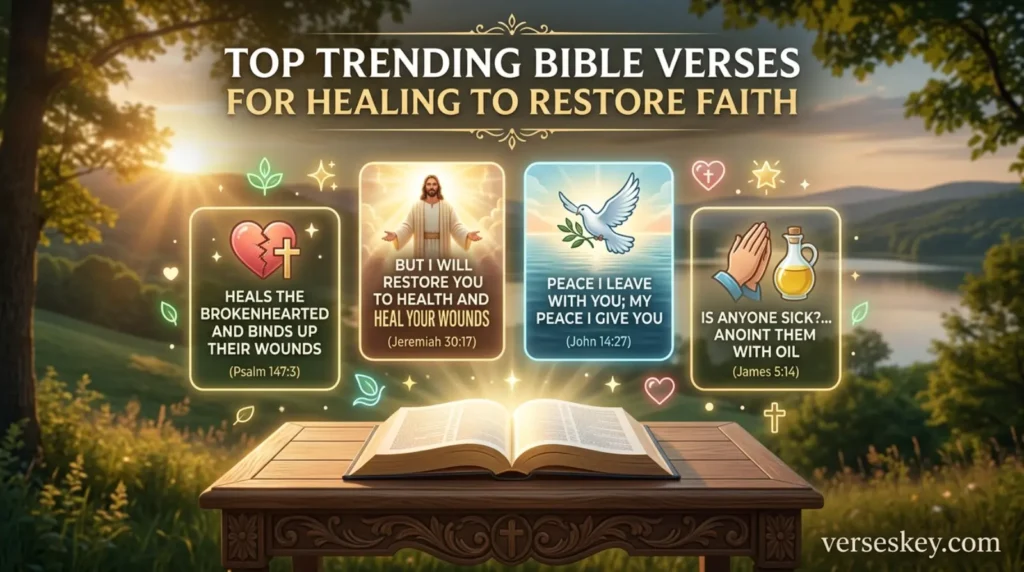
Psalm 147:3 — God Heals Broken Hearts
“He healeth the broken in heart, and bindeth up their wounds.” — Psalm 147:3, KJV
This verse speaks directly to emotional suffering.
Someone can appear strong outwardly while carrying deep internal wounds. Scripture assures hurting people that God understands the broken heart.
Isaiah 41:10 — God Gives Strength
“Fear thou not; for I am with thee: be not dismayed; for I am thy God.” — Isaiah 41:10, KJV
Isaiah 41:10 is especially meaningful during frightening seasons.
The promise focuses not only on changing circumstances but also on God’s presence and strength.
Jeremiah 17:14 — A Prayer for Healing
“Heal me, O LORD, and I shall be healed; save me, and I shall be saved.” — Jeremiah 17:14, KJV
Jeremiah presents healing as a direct prayer to God.
The verse demonstrates that believers can speak honestly with God about their needs. Prayer does not require complicated language. It can begin with a simple cry for help.
Jeremiah 30:17 — Restoration After Wounds
“For I will restore health unto thee, and I will heal thee of thy wounds, saith the LORD.” — Jeremiah 30:17, KJV
This passage was given within a specific historical context concerning God’s restoration of His people.
Christians should interpret such promises carefully rather than removing them from their original setting. At the same time, the passage reveals a consistent biblical theme: God is concerned with restoration.
Proverbs 17:22 — A Joyful Heart
“A merry heart doeth good like a medicine.” — Proverbs 17:22, KJV
Proverbs recognizes the connection between inner disposition and well-being.
The verse should not be used to blame people for illness or suggest that sadness causes every health problem. Instead, it offers wisdom about the value of joy, encouragement, and a hopeful spirit.
Matthew 11:28 — Rest for the Weary
“Come unto me, all ye that labour and are heavy laden, and I will give you rest.” — Matthew 11:28, KJV
Jesus invites weary people to come to Him.
This invitation remains powerful for Christians carrying emotional exhaustion, spiritual discouragement, or overwhelming responsibilities.
James 5:14–15 — Prayer for the Sick
“Is any sick among you? let him call for the elders of the church.” — James 5:14, KJV
James connects sickness with prayer and community support.
The passage encourages believers not to face suffering alone. Christian fellowship can provide prayer, practical help, encouragement, and companionship during difficult seasons.
Biblical Interpretations in Dreams or Real Life
People sometimes encounter healing Scriptures during dreams, prayer, worship, Bible reading, or ordinary moments of life. Such experiences can feel deeply personal.
Christians can receive encouragement from these moments without assuming that every experience contains a specific supernatural prediction.
Healing Verses in Dreams
A dream about healing may remind someone of hope, restoration, vulnerability, or the desire for relief.
However, Scripture does not teach Christians to treat every dream as a direct message from God.
A wise response is to compare the experience with biblical teaching and pray for discernment.
Healing Verses During Prayer
A verse may become especially meaningful while someone is praying for a sick family member or struggling with personal pain.
Such a passage can guide prayer and strengthen faith.
Instead of demanding a particular outcome, believers can pray with confidence while submitting the result to God’s wisdom.
Healing Verses During Reflection
Sometimes a familiar Scripture becomes meaningful during an unexpected season.
Psalm 23 may feel different after experiencing loss. Isaiah 41:10 may become more personal during fear. Psalm 147:3 may speak deeply after heartbreak.
The biblical text has not changed, but the reader’s circumstances have.
Healing Verses in Daily Life
A verse written in a journal, read during morning devotion, or remembered during a stressful moment can provide spiritual grounding.
The goal is not to search for hidden meanings in every event. The goal is to let Scripture shape thoughts, prayers, choices, and trust.
Practical Lessons & Faith Insights
- Trust God during uncertainty. Faith means continuing to rely on God’s character when circumstances remain unclear.
- Pray consistently. Bring physical, emotional, and spiritual needs honestly before God instead of carrying every burden alone.
- Remember God’s faithfulness. Recalling previous moments of God’s provision can strengthen confidence during present difficulties.
- Stay connected to Scripture. Regular Bible reading helps believers build a steady foundation instead of depending only on feelings.
- Seek wise support. Prayer and faith can exist alongside appropriate medical care, counseling, pastoral guidance, and practical help.
- Encourage people who suffer. A kind message, prayer, visit, or practical act of service can become a meaningful expression of Christian love.
- Avoid blaming yourself. Scripture does not give Christians permission to assume that every illness results from personal sin or weak faith.
- Accept God’s timing. Believers can ask boldly for healing while recognizing that God’s purposes and timing may differ from their expectations.
- Grow through hardship. Difficult seasons can develop patience, compassion, humility, endurance, and deeper dependence on God.
- Keep eternal hope. Christian hope ultimately rests in God’s promise of complete restoration and eternal life.
How This Biblical Meaning Applies Today
The message of healing Scripture remains highly relevant to modern Christian life.
People still experience illness, anxiety, grief, family conflict, disappointment, exhaustion, and spiritual dryness. The circumstances may change across generations, but the human need for hope remains.
Applying Healing Scriptures in Family Life
Families can read healing passages together during difficult seasons.
Parents can teach children that prayer is a place to bring fear and uncertainty. Family members can also learn that supporting someone who suffers requires patience rather than quick explanations.
A family shaped by biblical compassion can become a source of strength for someone who feels alone.
Applying Healing Scriptures to Spiritual Growth
Healing seasons can deepen spiritual maturity.
Instead of asking only, “How can I get out of this?” a believer may also ask, “What is God teaching me through this season?”
This question does not mean that suffering is automatically good. It means Christians can seek God’s wisdom even in painful circumstances.
Prayer, worship, Scripture reading, fellowship, gratitude, and quiet reflection can help maintain spiritual stability.
Applying Healing Scriptures to Relationships
Suffering often reveals how people treat one another.
Friends and relatives can demonstrate Christlike love by listening carefully, respecting boundaries, offering practical assistance, and praying faithfully.
Sometimes the most healing response is not a perfect explanation but a faithful presence.
Applying Healing Scriptures to Personal Development
Healing can also involve learning healthier spiritual and emotional habits.
A believer may begin setting aside regular prayer time, forgiving someone, asking for help, rebuilding trust, or developing a deeper understanding of God’s Word.
These steps do not replace God’s work. They can become practical expressions of faith.
Faith and Professional Care
Biblical faith does not require Christians to reject appropriate professional help.
A person facing serious illness should seek qualified medical care. Someone experiencing deep emotional distress may also benefit from appropriate professional support.
Prayer and practical care do not have to compete. Christians can seek God while responsibly using the help and wisdom available to them.
Frequently Asked Questions (FAQ)
What does Trending Bible Verses for Healing to Restore Faith mean?
Trending Bible Verses for Healing to Restore Faith are Scripture passages that encourage believers to trust God during sickness, emotional pain, spiritual struggles, and difficult seasons.
What is the spiritual meaning of healing in the Bible?
Biblical healing can refer to physical restoration, emotional comfort, spiritual renewal, forgiveness, and ultimately the complete restoration God promises.
What Bible verse is good for healing?
Psalm 147:3 is especially comforting because it says that God heals the brokenhearted and binds their wounds. Jeremiah 17:14 is also a direct prayer asking God for healing.
Does the Bible promise that every illness will be healed?
The Bible records many healing miracles and encourages prayer for the sick, but it does not teach that every illness will receive immediate physical healing in this present life.
What can Christians learn from healing Scriptures?
Christians can learn to pray faithfully, trust God’s character, seek wise support, encourage others, remain hopeful, and depend on God’s grace during difficult seasons.
How should Christians pray for healing?
Christians can pray honestly and specifically for healing while trusting God’s wisdom and timing. Prayer can include requests for physical recovery, emotional peace, spiritual strength, and guidance.
Can healing Bible verses help with emotional pain?
Yes. Scriptures such as Psalm 147:3 and Matthew 11:28 speak directly to broken hearts, weariness, burdens, and the need for God’s comfort.
What should I do when healing does not happen?
Continue seeking God through prayer and Scripture while accepting appropriate medical or professional care. Christian hope rests in God’s presence and eternal promises, not only in an immediate change of circumstances.
Conclusion
Trending Bible Verses for Healing to Restore Faith remind believers that suffering does not place them outside God’s care. Scripture speaks honestly about sickness, broken hearts, weakness, grief, and uncertainty while continually directing people toward God’s mercy and faithfulness.
From Psalm 147:3 to Isaiah 41:10, Jeremiah 17:14, Matthew 11:28, and James 5:14–15, the Bible gives Christians language for prayer and reasons for hope.
The biblical meaning of healing reaches beyond physical recovery. It includes God’s comfort, spiritual renewal, restored hope, faithful endurance, and the promise of ultimate restoration.
Some prayers may receive the answer we desperately desire. Other seasons may require long waiting, professional care, continued prayer, and trust without immediate resolution.
Even then, faith can remain.
God’s presence is not measured only by visible miracles. His grace can sustain a weary heart, strengthen a struggling believer, and give courage for another day.
When pain makes faith feel fragile, return to Scripture. Pray honestly. Seek wise support. Encourage someone else who is hurting. And remember that the God who cares for the brokenhearted has not forgotten you.
Healing may come through recovery, restoration, strength to endure, or the eternal hope found in Christ. In every season, believers can place their lives into God’s faithful hands.

I am Grace Willow passionate about sharing the wisdom and comfort of Scripture. Through my writing, I explore faith, hope, and the timeless lessons of the Bible. I aim to bring God’s Word to life in ways that inspire and guide daily living. My verses and reflections seek to encourage, uplift, and strengthen readers’ faith. For me, writing about Scripture is a way to connect hearts to God’s love.