
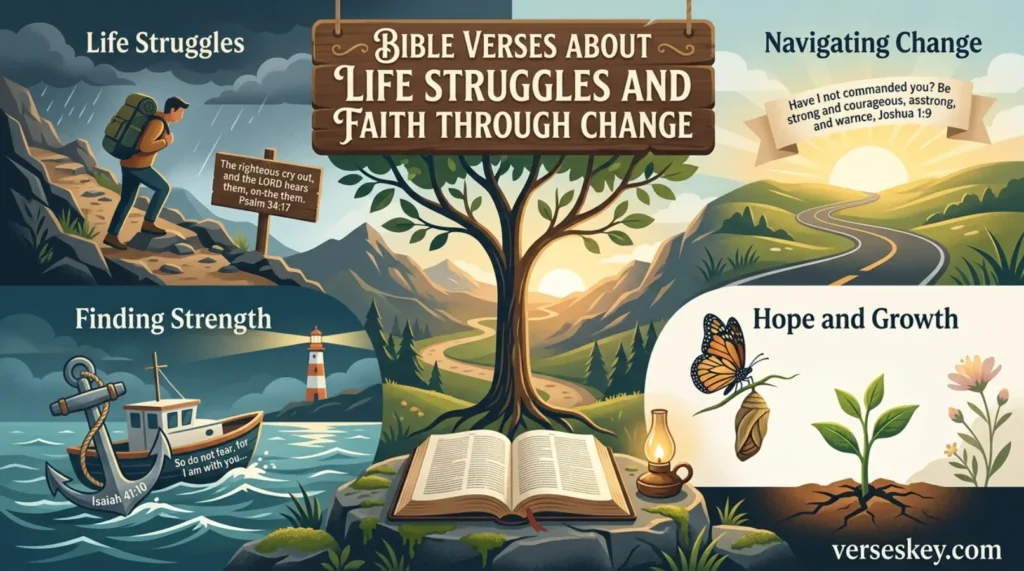
Bible Verses About Life Struggles and Faith offer comfort, strength, and hope when life feels overwhelming. These powerful Scriptures remind us to trust God during hardship, uncertainty, pain, and difficult seasons.
You’ll discover meaningful verses that encourage faith, patience, courage, and renewed confidence in God’s promises. Let these Bible verses about life struggles and faith strengthen your heart and remind you that God remains near.
Use our easy-to-copy option to save your favorite verses instantly, and share encouragement quickly with friends through WhatsApp. Find the right Scripture for your struggles and let God’s Word bring peace to your heart today.
Quick Answer
Bible verses about life struggles and faith remind Christians that hardship does not mean God has abandoned them. Scripture teaches believers to trust God’s presence, seek wisdom through prayer, persevere through trials, and remain confident in His promises, knowing that difficult seasons can strengthen faith, character, hope, and spiritual maturity.
Biblical Meaning of Bible Verses About Life Struggles and Faith
The Bible does not present “life struggles and faith” as one specific biblical phrase. Instead, Scripture develops this theme throughout its history. Human struggle appears early in Genesis after sin enters the world, bringing pain, conflict, toil, and separation from God’s original design. Faith also becomes a central biblical response, especially in the life of Abraham, who trusted God’s promise despite circumstances he could not fully understand.
Two important biblical words help explain this theme. The Hebrew word tsarah refers to distress, trouble, or a difficult situation. In the New Testament, the Greek word thlipsis describes pressure, affliction, distress, or tribulation.
James gives a powerful perspective:
“The testing of your faith produces perseverance.” — James 1:3
Biblically, hardship is not automatically evidence of God’s displeasure. Scripture shows that suffering can become an environment where perseverance, dependence, wisdom, compassion, and hope grow.
The deeper faith lesson is not that Christians should enjoy suffering. Instead, believers are encouraged to bring their struggles honestly before God while continuing to trust His character and promises. Prayer, Scripture, wise counsel, and faithful obedience become anchors during uncertain seasons.

Spiritual Significance and Symbolism
Life struggles often symbolize a spiritual journey from dependence on circumstances toward deeper dependence on God. Scripture frequently uses images such as valleys, storms, wilderness journeys, refining fire, and waiting seasons to communicate spiritual realities.
A valley can represent a season of weakness or uncertainty, yet Psalm 23 reminds believers that God walks with His people through the darkest places. A storm can represent fear and instability, while Jesus’ presence with His disciples demonstrates that God’s presence remains meaningful even when circumstances are frightening.
The refining image in Scripture also carries important symbolism. Gold is purified through heat, and biblical writers sometimes use refining language to describe the development of genuine faith.
These lessons can influence character and relationships:
- Struggles can teach humility instead of self-reliance.
- Difficult seasons can develop compassion for people who are hurting.
- Family trials can encourage relatives to pray together.
- Faithful endurance can become a testimony for younger generations.
- Forgiveness can protect relationships during stressful circumstances.
- Dependence on God can replace the pressure to control everything.
Biblical symbolism does not promise that every painful event has an immediately understandable purpose. It points instead to God’s ability to remain faithful and bring spiritual good through circumstances that believers may not understand.
Biblical Interpretations in Dreams or Real Life
Encountering struggles in daily life, prayer, dreams, or personal reflection can serve as a gentle reminder to examine where trust is being placed. Scripture encourages believers to respond thoughtfully rather than assuming every dream or difficult event contains a hidden divine message.
The Bible does contain meaningful dreams and visions, particularly in the lives of Joseph, Daniel, and others. At the same time, Scripture does not instruct Christians to treat every modern dream as a prophecy. Biblical wisdom calls for discernment, prayer, and alignment with God’s revealed Word.
A dream involving a difficult road may encourage reflection on perseverance. Images of storms can remind a believer of God’s presence during uncertainty. A recurring sense of fear may encourage deeper prayer and dependence on God’s promises.
These interpretations should remain grounded in Scripture rather than superstition. Helpful questions include:
- Am I trusting God during this season?
- Is fear controlling my decisions?
- What does Scripture teach me about this situation?
- Do I need wise Christian counsel?
- Is God inviting me to practice patience, forgiveness, courage, or compassion?
Romans 8:28 reminds believers that God works within the lives of those who love Him according to His purpose. The verse offers hope without suggesting that every painful circumstance will immediately make sense.
Practical Lessons & Faith Insights
Bible verses about life struggles and faith become most meaningful when biblical truth moves from reading into daily practice. Scripture invites believers to develop habits that sustain faith before, during, and after difficult seasons.
- Trust God in daily decisions: Bring important choices to God through prayer and compare your plans with biblical wisdom.
- Stay faithful in quiet seasons: Keep praying and obeying even when you do not see immediate results.
- Pray consistently with your family: Create simple moments for spouses, parents, children, and relatives to pray together.
- Build habits of daily devotion: Read Scripture regularly instead of waiting until a crisis arrives.
- Encourage and serve others: Personal hardship can increase sensitivity toward people carrying burdens of their own.
- Remember God’s past faithfulness: Write down answered prayers, lessons learned, and moments when God provided strength.
- Seek wise counsel: Trusted, mature Christians can provide perspective when emotions make decisions difficult.
- Practice biblical gratitude: Thank God for His character and daily provision even while honestly acknowledging pain.
- Choose perseverance: Continue taking faithful steps instead of allowing temporary hardship to define your identity.
- Give your fears to God: Philippians 4:6–7 connects prayer, thanksgiving, and God’s peace during anxious circumstances.
Bible Verses About Life Struggles and Faith for Hard Times
Scripture offers many passages that speak directly to hardship. These verses do not minimize suffering; they help believers face it with a biblical perspective.
Psalm 34:18 teaches that the Lord is near to those who are brokenhearted and crushed in spirit. This verse offers comfort to people who feel emotionally exhausted.
Isaiah 41:10 reminds God’s people not to fear because He promises His presence, strength, help, and support.
Psalm 46:1 describes God as a refuge and strength and a present help in trouble. The language emphasizes God’s availability during crisis.
John 16:33 records Jesus acknowledging that His followers will experience trouble in the world while directing them toward courage because He has overcome the world.
Romans 5:3–5 connects suffering with perseverance, character, and hope. Paul’s teaching presents a progression in which hardship can become part of spiritual formation.
2 Corinthians 4:8–9 describes believers as pressured and perplexed but not ultimately abandoned. The passage distinguishes hardship from defeat.
Philippians 4:13 is best understood within Paul’s discussion of learning contentment in different circumstances. Its message centers on Christ’s strength enabling faithful living through changing conditions.
These verses show a consistent biblical pattern: acknowledge reality, turn toward God, persevere in faith, and place hope in His character.
Bible Verses About Life Struggles and Faith for Strength
Strength in Scripture does not always mean receiving immediate relief. Sometimes biblical strength means having enough grace to continue faithfully through another day.
Isaiah 40:31 teaches that those who hope in the Lord receive renewed strength. The image of rising on wings communicates endurance beyond ordinary human resources.
Psalm 28:7 calls the Lord the strength and shield of His people. This language combines inner confidence with divine protection.
Nehemiah 8:10 famously connects joy in the Lord with strength. Biblical joy does not require perfect circumstances. It can arise from knowing that God remains trustworthy.
Ephesians 6:10 calls believers to be strong in the Lord and in His mighty power. The surrounding passage explains that Christian strength involves spiritual readiness rather than personal pride.
Psalm 55:22 encourages God’s people to cast their burdens on the Lord. This does not mean refusing responsibility. It means refusing to carry life’s burdens as if everything depends entirely on human strength.
Faith grows when believers learn to distinguish between what they can responsibly do and what they must surrender to God. Prayer can become the place where exhaustion becomes dependence and fear becomes trust.
Bible Verses About Life Struggles and Faith When You Feel Alone
Loneliness can make a difficult season feel even heavier. Scripture repeatedly reassures believers of God’s presence.
Psalm 23 presents the Lord as a shepherd who guides and accompanies His people. The psalm’s comfort becomes especially powerful in the valley, where the writer says he will fear no evil because God is with him.
Deuteronomy 31:8 declares that the Lord goes before His people and will not leave or forsake them.
Jesus also promised His disciples in Matthew 28:20 that He would be with them always. This promise appears at the conclusion of the Great Commission and connects God’s presence with faithful Christian service.
Hebrews 13:5 similarly reminds believers of God’s promise not to abandon them.
These passages do not suggest that Christians will never experience human loneliness. Instead, they provide a deeper spiritual assurance: loneliness does not mean divine abandonment.
When isolation becomes overwhelming, faith can include reaching toward healthy Christian community. Sharing burdens with trusted believers, attending church, asking for prayer, and offering honest fellowship can become practical expressions of God’s care.
Bible Verses About Life Struggles and Faith During Waiting
Waiting is one of the most challenging forms of faith because it requires trust without immediate answers.
Abraham waited for God’s promise. Joseph experienced years between receiving dreams and seeing significant fulfillment. David spent seasons running from danger before becoming king. These biblical stories demonstrate that God’s timing can involve long periods of uncertainty.
Psalm 27:14 says to wait for the Lord, be strong, and let the heart take courage. Waiting in Scripture is not passive hopelessness. It involves continuing to trust, obey, pray, and prepare.
Lamentations 3:25–26 teaches that the Lord is good to those who hope in Him and that waiting quietly for His salvation is good.
Isaiah 40:31 similarly connects waiting upon the Lord with renewed strength.
A waiting season can develop patience, clarify priorities, deepen prayer, and expose the difference between trusting God’s wisdom and demanding immediate outcomes.
Faith does not require pretending that waiting is easy. Biblical faith allows believers to say, “I do not understand the timing, but I will continue trusting God’s character.”
Bible Verses About Life Struggles and Faith Through Change
Change can create uncertainty because familiar routines, relationships, responsibilities, or expectations may disappear. Scripture provides stability by directing attention toward God’s unchanging character.
Malachi 3:6 declares that God does not change. Hebrews 13:8 teaches that Jesus Christ is the same yesterday, today, and forever.
These truths provide an important foundation during transitions. Circumstances may shift rapidly, but God’s faithfulness remains a reliable anchor.
Proverbs 3:5–6 encourages believers to trust the Lord rather than relying completely on their own understanding. The passage also calls them to acknowledge God in their ways.
Change can therefore become an opportunity to practice spiritual maturity:
- Pray before reacting.
- Seek biblical wisdom before making major decisions.
- Give yourself time to process loss.
- Maintain healthy relationships.
- Continue faithful responsibilities.
- Remember God’s previous faithfulness.
- Remain open to growth and correction.
Christian faith does not require certainty about every future detail. It calls believers to trust the One who sees the whole journey when they can see only the next step.
How This Biblical Meaning Applies Today
Modern life brings pressures that can test faith in powerful ways. Financial uncertainty, family responsibilities, workplace stress, relationship conflicts, disappointment, loneliness, and constant digital comparison can leave people emotionally exhausted.
Bible verses about life struggles and faith provide a framework for responding differently.
For personal growth, use difficult moments to examine priorities, strengthen prayer, and develop patience rather than reacting impulsively.
For marriage and family life, make prayer a shared practice. Couples can discuss worries honestly while choosing to seek God’s wisdom together. Parents can teach children that faith does not mean never feeling afraid; it means learning where to take fear.
For friendships, become someone who listens instead of offering quick answers. Galatians 6:2 encourages believers to carry one another’s burdens.
For spiritual maturity, learn to hold honest lament and confident hope together. The Psalms demonstrate that believers can tell God about pain while continuing to praise Him.
For everyday decisions, allow biblical principles to shape priorities, speech, relationships, work, generosity, forgiveness, and integrity.
The Christian meaning of struggle is not that pain itself is good. Rather, hardship can become a place where faith becomes more practiced, compassion becomes deeper, and dependence on God becomes more genuine.
Frequently Asked Questions (FAQ)
What does Bible Verses About Life Struggles and Faith mean in the Bible?
The theme describes how Scripture teaches believers to respond to hardship with trust in God, prayer, perseverance, wisdom, and hope. The Bible acknowledges suffering while emphasizing God’s presence and faithfulness.
What is the spiritual meaning of Bible Verses About Life Struggles and Faith?
The spiritual significance centers on trusting God during circumstances that cannot be controlled or fully understood. Difficult seasons can develop perseverance, character, compassion, humility, and deeper dependence on God.
Why is Bible Verses About Life Struggles and Faith important?
This biblical theme is important because everyone encounters difficult seasons. Scripture provides practical wisdom and spiritual encouragement for facing fear, loss, uncertainty, disappointment, loneliness, and waiting without abandoning faith.
What Bible verse talks about struggles and faith?
James 1:2–4 is one of the clearest passages because it explains that the testing of faith produces perseverance. Romans 5:3–5 also connects suffering with perseverance, character, and hope.
Does the Bible say Christians will have struggles?
Yes. Jesus directly acknowledged that His followers would experience trouble in the world in John 16:33. Scripture does not promise a life without hardship; it points believers toward God’s presence and strength during hardship.
How should Christians respond to difficult seasons?
Christians are encouraged to pray, trust God, seek biblical wisdom, remain faithful, accept appropriate support from others, and continue doing what is right. Scripture also allows honest lament rather than requiring believers to hide their pain.
Can struggles strengthen faith?
According to passages such as James 1:2–4 and Romans 5:3–5, trials can contribute to perseverance, character, and hope. This does not mean every painful event is easy or immediately understandable.
What is a good Bible verse for someone going through a hard time?
Psalm 34:18 is especially comforting because it emphasizes God’s nearness to the brokenhearted. Isaiah 41:10 is also encouraging because it focuses on God’s presence, strength, help, and support.
Conclusion
Bible verses about life struggles and faith remind us that hardship is not the end of the story. Scripture presents faithful people who cried, waited, questioned, endured, prayed, and continued walking with God. Their experiences show that genuine faith can coexist with tears and uncertainty.
The biblical meaning of struggle points beyond circumstances to God’s character. He remains a refuge in trouble, a source of strength in weakness, a guide during uncertainty, and a faithful presence through seasons we cannot fully understand.
Faith does not require knowing every answer. It invites us to trust God one step at a time, remain rooted in His Word, pray honestly, love others faithfully, and keep hope alive.
If you are walking through a difficult season today, remember that your struggle does not make you forgotten. God can meet you in the valley, strengthen you in the waiting, and teach your heart to trust Him more deeply.
Let these Bible verses about life struggles and faith encourage you to keep going, keep praying, and keep believing. Share this message with someone who may need a reminder today that difficult seasons can be faced with faith, hope, and the assurance of God’s faithful presence.

I am Grace Willow passionate about sharing the wisdom and comfort of Scripture. Through my writing, I explore faith, hope, and the timeless lessons of the Bible. I aim to bring God’s Word to life in ways that inspire and guide daily living. My verses and reflections seek to encourage, uplift, and strengthen readers’ faith. For me, writing about Scripture is a way to connect hearts to God’s love.