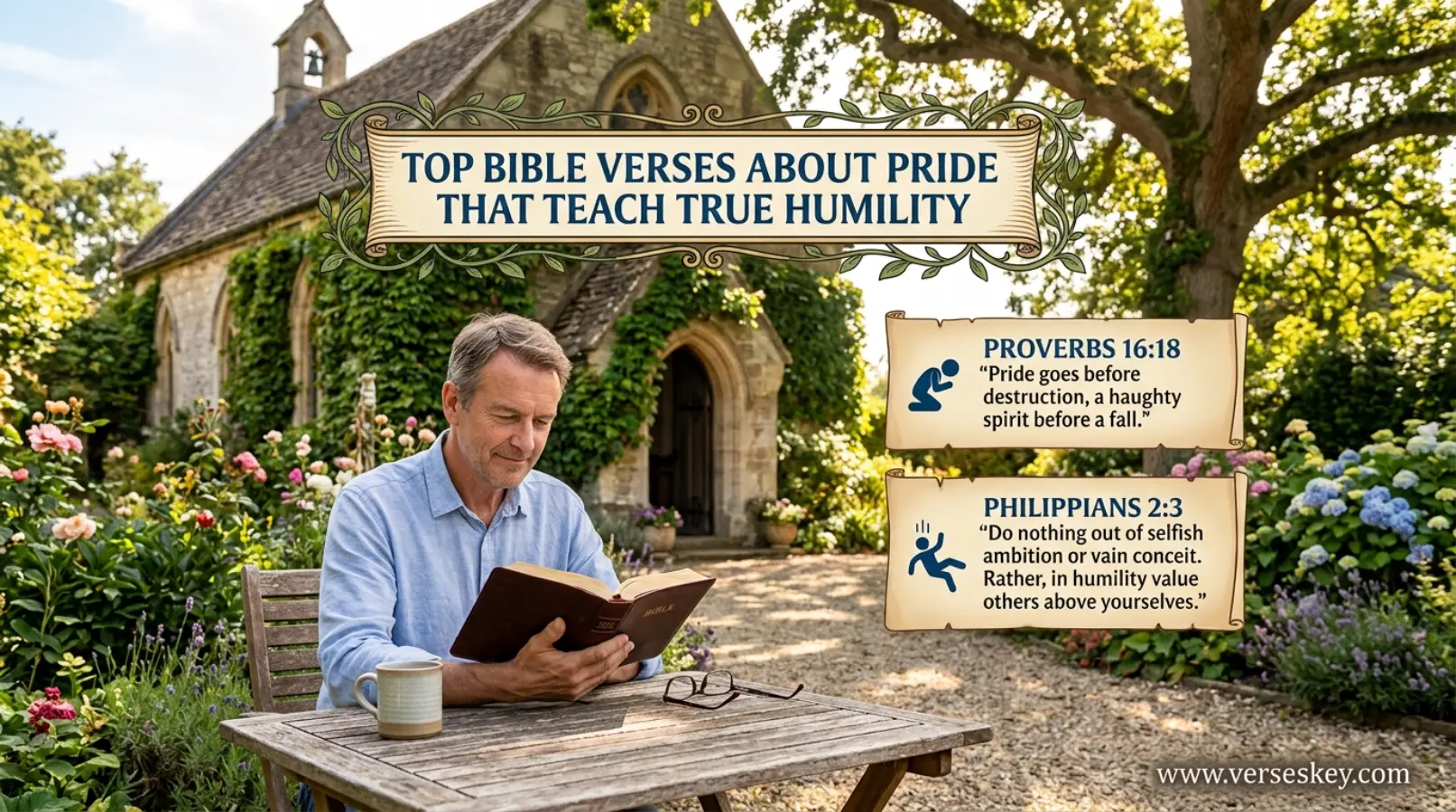
Top Bible Verses About Pride That Teach True Humility offer timeless wisdom for developing a humble and faithful heart. These Scriptures provide meaningful guidance for anyone seeking to grow in faith and live with greater humility.
These powerful Bible verses reveal how pride can influence our choices, relationships, and walk with God. They encourage self-reflection, obedience, wisdom, and genuine dependence on the Lord.
Let these biblical teachings guide your heart toward humility, wisdom, and a deeper relationship with God. Our easy-to-use copy option helps you save your favorite verse instantly, while the quick WhatsApp share button makes it simple to encourage friends and family. Discover Top Bible Verses About Pride That Teach True Humility and share a meaningful Scripture today.
Quick Answer:
Top Bible Verses About Pride warn that arrogance can lead to spiritual downfall, while humility brings wisdom and grace. Proverbs 16:18 teaches that pride comes before destruction. Scripture calls believers to humble themselves before God, trust His wisdom, serve others, and recognize that every good gift ultimately comes from Him.
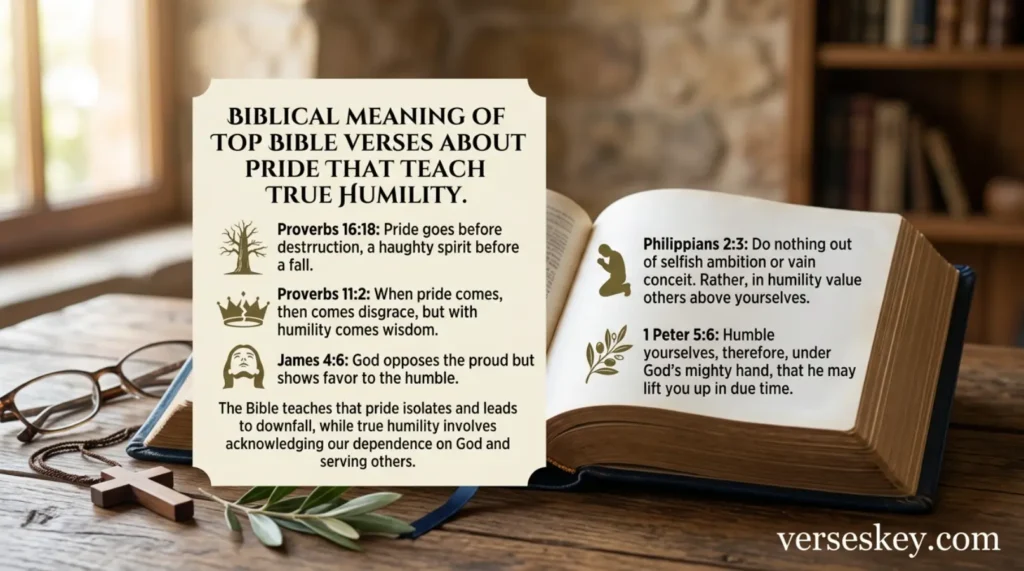
Biblical Meaning of Top Bible Verses About Pride That Teach True Humility
The Bible’s warning about pride begins very early in its story. Genesis 3 portrays humanity reaching beyond God’s command and trusting an alternative voice. Although the word “pride” is not used directly in Genesis 3, the episode illustrates the biblical pattern of self-rule: wanting wisdom, status, or independence apart from God.
One of the clearest statements appears in Proverbs 16:18: “Pride goeth before destruction, and an haughty spirit before a fall.” This wisdom teaching connects arrogance with downfall and teaches that human beings should never place themselves above God’s wisdom.
In Proverbs 16:18, “pride” translates the Hebrew ga’on, a word associated with exaltation, arrogance, or excessive self-importance. “Haughty spirit” reflects the idea of an elevated or lifted-up attitude. Biblical interpretation therefore focuses not merely on outward behavior but on the posture of the heart.
The spiritual lesson is straightforward: pride says, “I can depend on myself,” while humility says, “I need God.” True humility does not mean thinking that you have no value. It means recognizing God as the source of your life, abilities, wisdom, and blessings.
Spiritual Significance and Symbolism
The spiritual significance of pride becomes clearer when Scripture is viewed as a whole. Pride repeatedly appears as a barrier between human beings and dependence upon God. Humility, by contrast, creates room for repentance, instruction, prayer, gratitude, and spiritual growth.
Proverbs 11:2 says, “When pride cometh, then cometh shame: but with the lowly is wisdom.” The contrast is important. Biblical humility is not weakness. It is a condition in which a person becomes teachable and willing to receive wisdom.
Jesus demonstrated this principle through His life of service. Philippians 2:5–8 describes Christ’s willingness to humble Himself and become obedient. His example gives Christian humility its deepest meaning: believers are called to place obedience and love above personal status.
Pride can affect generations when it becomes a pattern within a family. Children may learn arrogance by observing how adults respond to correction, success, disagreement, or failure. Humility can also become a family legacy when parents model forgiveness, prayer, gratitude, service, and willingness to admit mistakes.
In relationships, humility changes the question from “How can I win?” to “How can I love faithfully?” That shift can strengthen marriages, friendships, families, churches, and communities.
Biblical Interpretations in Dreams or Real Life
Encountering pride as a theme in a dream, prayer, sermon, Bible study, or personal reflection should not automatically be treated as a prediction of future events. Scripture does not teach that every dream carries a divine message. Instead, such experiences can become opportunities for prayerful reflection when interpreted carefully and consistently with God’s Word.
If pride repeatedly comes to mind during prayer, it may be helpful to ask whether there are areas where self-reliance, stubbornness, comparison, or the desire for recognition has become too important. James 4:6 provides a reassuring foundation: “God resisteth the proud, but giveth grace unto the humble.”
That verse does not invite fear. It points toward grace and change.
A person who notices pride in daily life can respond by praying for wisdom, seeking forgiveness, listening to trusted Christian counsel, and making practical changes. A dream about falling, rising, being corrected, or losing status should not be assigned a fixed biblical meaning without context.
The safest Christian approach is to test spiritual impressions against Scripture rather than allowing a dream or feeling to become the authority. God’s Word remains the foundation for biblical interpretation.
When pride becomes visible, the appropriate response is not despair. It is humble repentance, renewed trust, and confidence in God’s mercy.
Practical Lessons & Faith Insights
- Trust God in daily decisions: Ask for God’s wisdom before making choices instead of assuming that personal understanding is always enough.
- Stay faithful in quiet seasons: Humility grows when you continue obeying God even when nobody notices your efforts.
- Pray consistently with your family: Family prayer can teach children that dependence upon God is a strength rather than a weakness.
- Build habits of daily devotion: Reading Scripture and reflecting on God’s character can correct self-centered thinking.
- Accept correction graciously: A teachable heart can turn criticism into an opportunity for wisdom and maturity.
- Encourage and serve others: Look for ways to honor other people without constantly seeking recognition.
- Practice gratitude: Thank God for abilities, opportunities, relationships, and accomplishments rather than treating them as proof of personal superiority.
- Admit mistakes honestly: Saying “I was wrong” can be a meaningful expression of Christian humility.
- Celebrate others: Rejoicing in someone else’s success weakens the temptation to compare yourself with them.
- Remember God’s authority: Personal achievement has value, but it should never replace dependence upon the One who gives life and every good gift.
How This Biblical Meaning Applies Today
Modern life can make pride difficult to recognize because self-promotion is often rewarded. Social media encourages people to display achievements, possessions, appearance, opinions, and accomplishments. Career success can also create the temptation to measure personal worth by position or recognition.
The biblical answer is not to reject achievement. Christians can work diligently, develop their abilities, celebrate progress, and pursue excellence while remembering that success does not make one person more valuable than another.
In marriage and family life, humility means listening before responding, apologizing without excuses, and caring about another person’s needs. A humble spouse does not have to win every argument. A humble parent can admit mistakes and demonstrate that correction is part of growth.
In friendships and church communities, humility encourages cooperation rather than competition. It allows people to appreciate different gifts without feeling threatened by them.
For personal spiritual maturity, one practical question can be powerful: “Am I becoming more dependent on God as I become more successful?” If success increases gratitude, generosity, obedience, and service, it can become an opportunity to glorify God.
True humility does not erase confidence. It places confidence under God’s authority.
Frequently Asked Questions (FAQ)
What does Top Bible Verses About Pride That Teach True Humility mean in the Bible?
This theme refers to Scripture passages that warn against arrogance, self-exaltation, and dependence upon oneself while teaching believers to walk humbly with God. These verses show that humility involves obedience, wisdom, gratitude, repentance, and service.
What is the spiritual meaning of pride?
Biblically, sinful pride is an elevated view of oneself that disregards God’s authority or places personal wisdom above His instruction. It can produce arrogance, stubbornness, comparison, boasting, and resistance to correction.
Why is pride important in the Bible?
Pride matters because Scripture repeatedly connects it with spiritual danger and downfall. Proverbs teaches that pride can precede destruction, while humility is associated with wisdom, grace, and dependence upon God.
What Bible verse talks about pride?
Proverbs 16:18 is one of the best-known Bible verses about pride: “Pride goeth before destruction, and an haughty spirit before a fall.” The verse presents pride as a warning against arrogance and false confidence.
What does the Bible say about humility?
The Bible presents humility as a virtue that involves submitting to God, serving others, accepting correction, and recognizing one’s dependence upon the Lord. James 4:6 teaches that God gives grace to the humble.
Is pride always a sin according to the Bible?
Scripture distinguishes sinful arrogance from appropriate gratitude for God’s gifts. Healthy confidence, responsible leadership, and recognizing genuine abilities are not inherently sinful. Pride becomes spiritually dangerous when self-exaltation replaces humility and dependence upon God.
How can Christians overcome pride?
Christians can fight pride through prayer, Scripture, gratitude, confession, service, accepting correction, and remembering God’s sovereignty. Philippians 2 encourages believers to follow Christ’s example of humility and self-giving love.
What is the opposite of biblical pride?
Biblical humility is the opposite of sinful pride. Humility recognizes God’s authority, values other people, welcomes wisdom, accepts correction, and gives God credit rather than demanding personal glory.
More Powerful Bible Verses About Pride and Humility
Proverbs 8:13
“The fear of the LORD is to hate evil: pride, and arrogancy, and the evil way…”
This verse connects reverence for God with rejecting pride. A healthy fear of the Lord changes what the heart loves and hates. Spiritual wisdom therefore involves more than collecting biblical knowledge; it requires allowing God’s character to shape our attitudes.
Proverbs 11:2
“When pride cometh, then cometh shame: but with the lowly is wisdom.”
The verse presents a striking contrast between pride and humility. A humble person remains teachable, while an arrogant heart can become resistant to correction.
Proverbs 16:5
“Every one that is proud in heart is an abomination to the LORD.”
This strong language shows how seriously Scripture treats inward arrogance. Biblical pride is ultimately a spiritual issue because it challenges proper dependence upon God.
Proverbs 16:18
“Pride goeth before destruction, and an haughty spirit before a fall.”
This is perhaps the clearest summary of the danger of pride. It warns that exaggerated confidence can create the very conditions that lead to failure.
Proverbs 18:12
“Before destruction the heart of man is haughty, and before honour is humility.”
The verse teaches that humility and honor are not enemies. In God’s wisdom, humility can prepare the heart for responsible influence because it keeps success from becoming self-worship.
Proverbs 27:2
“Let another man praise thee, and not thine own mouth.”
This Scripture challenges the desire for constant self-promotion. It encourages believers to let character and faithful work speak instead of making personal praise the goal.
Micah 6:8
“And what doth the LORD require of thee, but to do justly, and to love mercy, and to walk humbly with thy God?”
Micah brings humility into everyday discipleship. Walking humbly with God involves justice, mercy, and a life shaped by God’s character.
Matthew 23:12
“And whosoever shall exalt himself shall be abased; and he that shall humble himself shall be exalted.”
Jesus directly challenges status-seeking and self-exaltation. His teaching turns ordinary ideas about greatness upside down and places humility at the center of faithful living.
James 4:6
“God resisteth the proud, but giveth grace unto the humble.”
This verse gives both a warning and an invitation. Pride creates resistance to God’s work, while humility positions the believer to receive His grace.
1 Peter 5:5–6
“God resisteth the proud, and giveth grace to the humble.”
Peter encourages Christians to clothe themselves with humility and entrust themselves to God’s care. Humility therefore includes trusting God’s timing rather than desperately trying to control recognition, success, or status.
What Jesus Teaches About Pride and Greatness
Jesus repeatedly challenged the world’s definition of greatness. His teaching in Matthew 18:1–4 points believers toward childlike humility rather than status-seeking. The lesson is not that Christians should become immature. Instead, disciples are called to abandon self-importance and dependence upon personal rank.
Jesus also taught that greatness is connected with serving others. Mark 10:43–45 explains that whoever desires to become great should become a servant. This provides an important biblical interpretation of humility: humility is active.
It is possible to speak gently while still being proud. It is also possible to hold a position of leadership while remaining genuinely humble. The deeper issue is the heart’s orientation toward God and other people.
Christ’s washing of His disciples’ feet in John 13 provides another powerful picture of humility. The Lord and Teacher willingly performed an act of service that communicated love without demanding status.
For Christians today, this example reaches into ordinary life. Humility may look like listening to a spouse, helping a family member, encouraging a coworker, serving at church, forgiving an offense, or quietly doing something beneficial without receiving applause.
The spiritual significance is profound: Christian humility is not simply thinking less about oneself. It is becoming free enough from self-importance to love and serve others faithfully.
Pride, Wisdom, and the Fear of the Lord
Biblical wisdom repeatedly connects humility with teachability. A proud person may have knowledge but refuse correction. A humble person may recognize limitations and therefore remain open to learning.
Proverbs 9:10 states, “The fear of the LORD is the beginning of wisdom.” This principle helps explain why humility is central to biblical wisdom. If God is the ultimate source of truth, human understanding must remain submitted to Him.
This has practical implications for decisions about money, relationships, parenting, work, leadership, and spiritual life. A humble believer can say, “I may not know everything. I need God’s wisdom.”
Humility also protects people from becoming trapped by comparison. When personal worth depends on being smarter, richer, more successful, or more admired than someone else, contentment becomes difficult.
Scripture redirects attention toward faithfulness. God does not call every believer to the same position, gifts, or responsibilities. He calls His people to faithfully use what He has entrusted to them.
The result is a healthier understanding of success. Success becomes an opportunity for stewardship rather than self-glorification. Wisdom becomes a gift to practice rather than a reason to boast.
How Pride Can Affect Family and Relationships
Pride rarely remains isolated inside one person’s heart. It can influence communication, marriage, parenting, friendships, and church relationships.
A proud attitude may make someone unwilling to apologize, listen, compromise, or accept responsibility. Over time, small conflicts can become deep wounds when nobody is willing to take the first humble step.
Humility creates a different atmosphere. It encourages people to listen carefully and respond with grace. It makes forgiveness easier because the goal is restoration rather than victory.
Parents can teach humility through ordinary examples. Saying “I made a mistake” teaches children that admitting failure is not shameful. Thanking God for blessings teaches gratitude. Serving others teaches that dignity does not depend upon receiving attention.
Marriage can also benefit from biblical humility. Spouses who stop keeping score and start seeking one another’s good can develop stronger communication and trust.
Ephesians 4:2 encourages believers to walk with lowliness, gentleness, patience, and forbearance in love. These qualities show that biblical humility is relational. It is demonstrated through the way we treat people.
A humble home does not mean a conflict-free home. It means disagreements can be approached with patience, honesty, prayer, and a willingness to pursue peace.
A Prayer for Freedom From Pride
Heavenly Father, help me recognize pride when it quietly enters my thoughts, words, decisions, and relationships. Teach me to depend upon You rather than trusting my own wisdom.
Give me a humble heart that welcomes correction, celebrates the success of others, and remembers that every good gift comes from You. Help me serve without seeking applause and forgive without demanding recognition.
Teach me to follow the example of Jesus, who demonstrated greatness through obedience, love, sacrifice, and service. Strengthen my family and relationships through patience and humility.
When I experience success, keep me grateful. Then I experience failure, keep me teachable. When I receive correction, give me wisdom. And when I am tempted to compare myself with others, remind me that my identity rests in You.
Lord, help me walk humbly with You each day. May my words, choices, relationships, and accomplishments point beyond myself and bring honor to Your name.
Amen.

Conclusion
Top Bible Verses About Pride That Teach True Humility reveal a consistent biblical message: pride can pull the heart toward self-exaltation, while humility turns the heart toward God. Proverbs, the teachings of Jesus, and the writings of the apostles repeatedly call believers away from arrogance and toward wisdom, grace, service, gratitude, and obedience.
The biblical meaning of humility is not weakness or low self-worth. It is the strength to recognize God’s authority, receive correction, value others, admit mistakes, and trust the Lord with both success and failure.
Proverbs 16:18 remains a timeless warning, but Scripture’s message does not end with the danger of pride. God’s Word also offers grace to the humble. That means every person can begin again through repentance, prayer, and a renewed commitment to follow Christ.
May these Top Bible Verses About Pride That Teach True Humility encourage you to examine your heart with honesty and walk with God with greater faithfulness. Let humility shape your home, strengthen your relationships, and deepen your spiritual life.
A humble heart does not need to prove its greatness; it quietly trusts God, serves others, and gives Him the glory.
If these Scriptures encouraged you, share this message with someone who may need a reminder that true greatness begins with a heart surrendered to God.

I am Grace Willow passionate about sharing the wisdom and comfort of Scripture. Through my writing, I explore faith, hope, and the timeless lessons of the Bible. I aim to bring God’s Word to life in ways that inspire and guide daily living. My verses and reflections seek to encourage, uplift, and strengthen readers’ faith. For me, writing about Scripture is a way to connect hearts to God’s love.